
Not for human consumption · Research use only
Morris Peppy
Research vial beside a laboratory report and inspection loupe
The buyer’s visual guide

How to read a Certificate of Analysis for Philippine research peptides

A real report can still belong to a different batch. Here’s how to follow the evidence from laboratory paper to the product in your hand.

8 minute readEducational guideUpdated September 2026
Follow the evidence ↓
The central limitation

A lab only sees the sample it receives.

A COA records what happened to one submitted sample under specific test conditions. It does not automatically describe the seller’s whole inventory—or even the vial sitting in front of you.

The traceability chain

Three links. One missing link breaks the claim.

Verification confirms the paper. Traceability connects that paper to inventory and then to your vial.

01

Lab report

Verify the results directly with the issuing laboratory, through its report portal or the QR code on the report. Every Morris Peppy report opens on our Lab Results page, and we add the laboratory’s own verification link as soon as the lab publishes it.
→
02

Seller’s batch

Look for a lot number, batch size, test date, sample count, and selection method.

→
03

Your vial

Match the lot, label, stated quantity, and documented packaging details.

What the evidence means

Verification and traceability are different jobs.

A portal can prove that the lab issued a document. It cannot prove your vial came from the submitted sample’s batch.

Document authenticity

A verified report is a strong first step.

Compare the report number, sample description, date, and results with the laboratory’s own record, reached through the lab’s portal or the report’s QR code—not merely the seller’s image.

It can supportThe lab issued this report.
It cannot establishThis report belongs to your vial.
Vial photograph

A photo adds a point of comparison.

The most useful image clearly shows the submitted vial’s label, lot number, cap, and stated quantity. Missing photos are common; their absence is not evidence of fraud.

COA reuse

A real report can outlive its batch.

Batch size and current inventory turn an indefinite claim into a specific question: “Is the product shipping today still from this tested lot?”

What makes a photo count

A lot number is an assertion. A vial photo is a physical claim.

Typed text costs nothing to copy onto a listing—or an unrelated vial. A photograph showing that lot number on a whole physical vial is harder to fake casually because the labeled object had to exist when the image was taken.

A missing photo is common and neutral. A strong photo is an asymmetric positive signal: an honest seller loses nothing by providing it, while a seller reusing or relabeling stock has a reason to avoid the trail.

It still is not proof. A seller could stage one “hero vial” and ship something else. The photo simply raises the cost of the lie.

The lot is legible in the image

Read it from the vial itself, rather than trusting a caption beside the photo.

The cap color is clear and consistent

Some manufacturers assign cap colors by production run or date. When that convention is documented, the unobscured color provides a second batch detail; it is not meaningful by itself.

The vial and COA are shown together—or clearly paired

Two unrelated images still leave the reader trusting that they came from the same submission.

The whole object is visible

A natural, uncropped view is stronger than a screenshot of a screenshot or a tight crop showing only convenient text.

The photo is recent and specific to this sale

A promotional image reused for months does not connect today’s inventory to the tested batch.

The reuse problem

A genuine COA can be recycled forever.

A report has finite scope: it covers the specific batch that was tested. When those vials sell, the COA is spent. Nothing automatically stops the same verified document from remaining online while different, untested stock ships under it.

500 vials ≠ foreverIf a declared 500-vial batch sells out, its COA does not transfer to vial 501.

No document fully prevents reuse. The practical goal is to make the claim specific, costly to fake, and easier to challenge.

1

Declare the batch size

“This batch contained 500 vials” turns a vague trust question into a falsifiable one: “This report tested a 500-vial batch on this date—is today’s vial still from it?” Our Lab Results show each batch’s size and remaining vials.

2

Use a photo tied to this sale

A recent vial photo connects current inventory to the claim. One image recycled across months of listings is functionally no defense against COA reuse.

3

Check volume against time

No individual buyer can verify sales volume. Across buyer reports, however, a “500-vial batch” apparently selling at volume eight months later becomes a pattern worth questioning.

PASSED
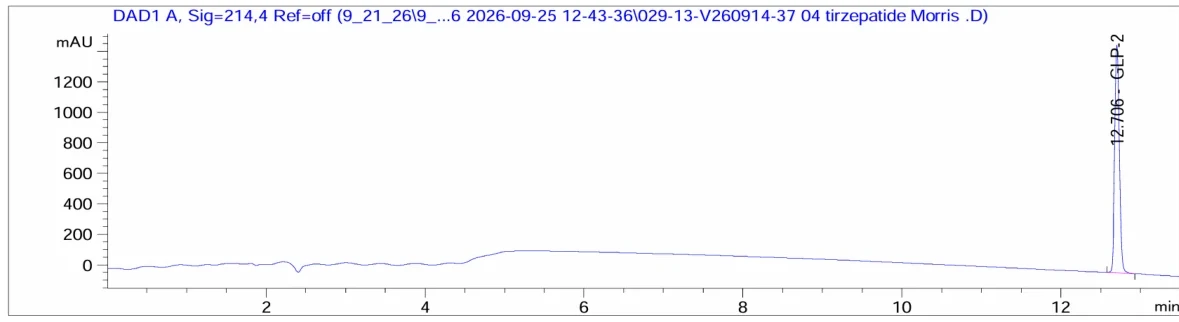
SampleGLP-2 (TZ) · 30 mg
Lot / batchMP-T30-BK-A04 · 210 vials
Laboratory IDV260914-37 004
Sample selection5 vials from the batch
Reported purity>99.80%
HPLC chromatogram from report V260914-37 004 showing a single GLP-2 peak at 12.706 minutes
Match the lotCheck the lab IDRead the method
COA anatomy

Don’t let “99%” end the inspection.

1

Identity and quantity

Purity is not identity, and neither confirms the advertised milligram amount.

2

Units and limits

“Pass,” a measured value, and a reporting ceiling communicate different things.

3

Method and sample

Ask what method was used, how many vials were tested, and how they were selected.

The useful test panel

Purity is only one tile in the picture.

Each test answers a different question. None carries the whole quality claim by itself.

Composition

Purity · HPLC

How much of the detected chromatographic signal is assigned to the target peak?

Confirmation

Identity · Mass spec

Is the sample’s measured mass consistent with the peptide named on the report?

Contaminants

Heavy metals

Which elements were measured, in what units, and against which limits?

Microbiology

Microbial / sterility

USP <61> microbial limits are the floor. Sterility is a stricter test that few sellers run.

Bacterial toxins

Endotoxin

Evidence improves from Pass/Fail only, to a numeric result, to a result with spike recovery and CV data that help expose assay interference.

Market-specific

Adulterant screen

Informal supply chains justify going beyond typical vendor frameworks. Ask what was screened—including fentanyl—by which method, and at what cutoff.

Save this checklist

Five questions before you trust the paper.

Does the COA identify a specific lot—and ideally its batch size?□
Does a recent, clearly paired photo show your vial’s lot, label, quantity, and documented cap color?□
Can you verify the report through the issuing laboratory?□
Are the sample count and selection method disclosed?□
Does the panel go beyond purity?□
Morris Peppy worked example

Our own report, same five questions.

GLP-2 (TZ) 30 mg, lot MP-T30-BK-A04. Vanguard Laboratory report V260914-37 004, released September 30, 2026: purity >99.80%, 27.75 mg measured, all eight checks passed.

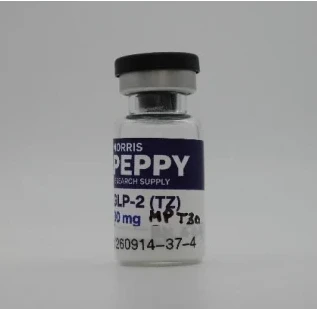
The laboratory’s photo of our GLP-2 (TZ) 30 mg vial with a black cap, from report V260914-37 004
The laboratory’s photo of the vial it tested, from page 1 of the report.

Read the full report →See this lot’s results →

  1. Does the COA identify a specific lot, and its batch size?Yes. Lot MP-T30-BK-A04 is printed on the report. The batch was 210 vials, and Lab Results shows how many remain.
  2. Does a paired photo show the vial’s label, quantity and cap?Yes. Page 1 carries the laboratory’s own photo of the tested vial: our label, GLP-2 (TZ) 30 mg, the black cap and the lab’s sample number.
  3. Can you verify the report with the issuing laboratory?Yes. Vanguard publishes this report on its own verification site, and the link is on the lot card on Lab Results.
  4. Are the sample count and selection method disclosed?Yes. Five vials from this batch were sent to the lab for this report.
  5. Does the panel go beyond purity?Yes. Eight checks: identity, purity, quantity, fentanyl, heavy metals, endotoxin, sterility (USP <71>) and container closure integrity.

Five of five. And when a check is still open, we show that too: a report you can check beats a perfect-looking one you can’t.

See how we test Philippine research peptides, and the lots we rejected on Lab Results. Read why we threw away 710 vials.